Can You Buy YouTube Watch Hours for Monetization?
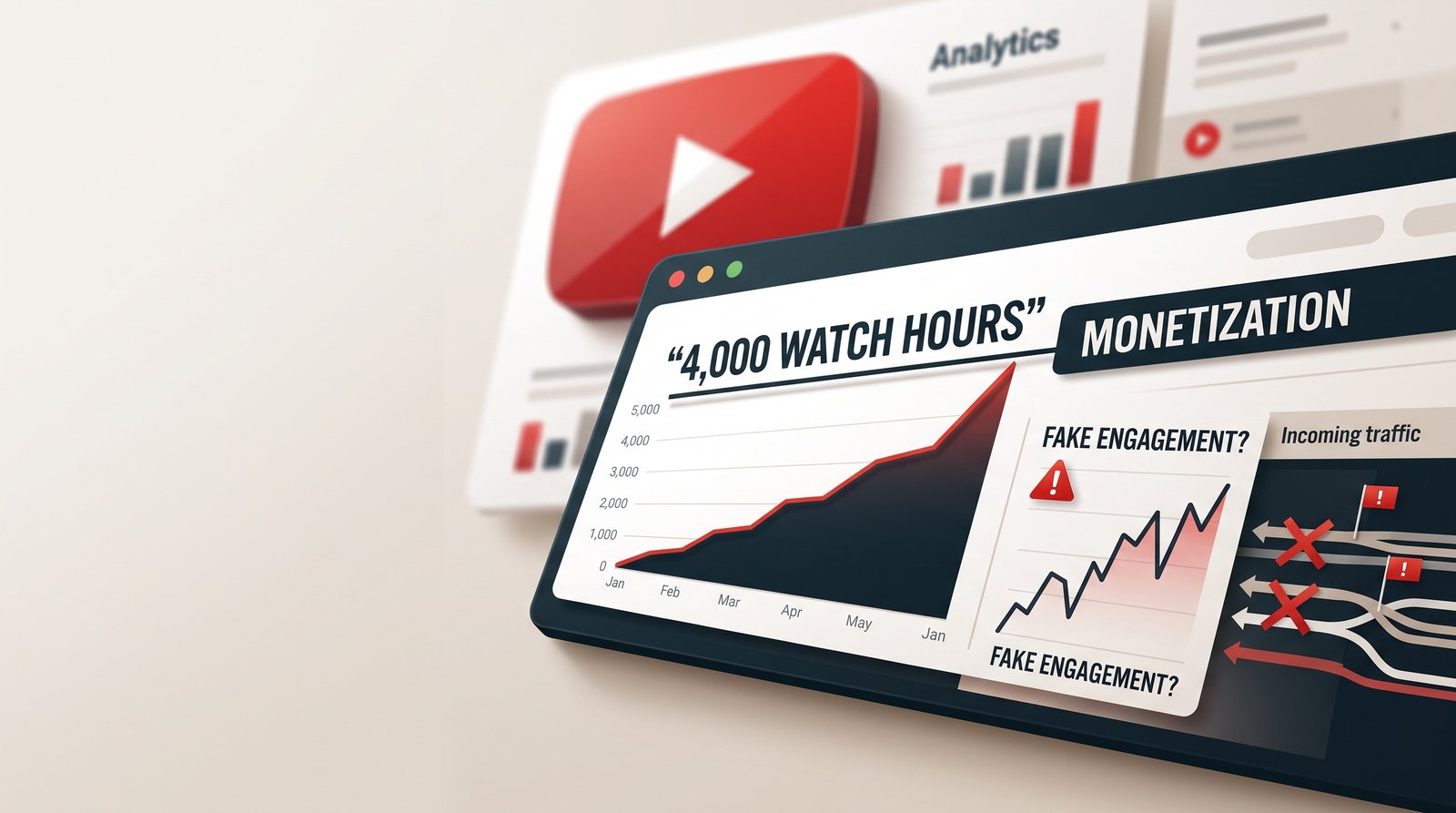
Can You Buy YouTube Watch Hours for Monetization? What Actually Happens
If you're close to YouTube's monetization threshold and staring down months of grinding for watch hours, paying for a shortcut is tempting. Here's the honest answer, backed directly by YouTube's own policy pages — not by a provider trying to sell you the shortcut.
What YouTube's Monetization Requirements Actually Are (2026)
To unlock full ad revenue and YouTube Premium revenue sharing, YouTube requires one of two paths:
- 1,000 subscribers + 4,000 valid public watch hours in the last 12 months, or
- 1,000 subscribers + 10 million valid public Shorts views in the last 90 days
There's also an earlier, more limited tier (fan-funding features only — not ad revenue) available in eligible regions: 500 subscribers, 3 public uploads in the past 90 days, and either 3,000 watch hours or 3 million Shorts views. Watch time earned from Shorts appearing in the Shorts feed does not count toward the 4,000-hour long-form threshold — a distinction several competing guides get wrong or leave vague.
What YouTube's Policy Actually Says About Buying Engagement
This is the part most "buy watch hours" providers either skip or bury: YouTube's Fake Engagement Policy explicitly states that the platform doesn't allow anything that artificially increases the number of views, likes, comments, or other metrics — whether through automatic systems or by serving videos to unsuspecting viewers. It separately and specifically names linking to or promoting third-party view count or subscriber gaming services as a violation.
This isn't ambiguous, and it isn't a matter of finding a "high enough quality" provider. The policy addresses the practice itself, not just low-quality bot traffic. Any provider claiming their service is "compliant" or "doesn't violate policy" because it uses real devices or residential IPs is describing a harder-to-detect version of a practice YouTube's policy already prohibits — not a compliant one.
Why "High-Quality" Provider Claims Don't Change the Policy Risk
Some providers market a meaningful distinction between bot-farm traffic and "real device" traffic, and it's true that these produce different detection risk profiles. But detection risk and policy risk are two separate things:
- Detection risk is about whether YouTube's automated systems flag the activity.
- Policy risk is that the activity is against the rules regardless of whether it's caught.
Consequences named directly in YouTube's own policy pages include content removal and channel termination. Claims from providers about "zero-strike records" or guarantees that their traffic is "indistinguishable from organic" are not something a buyer can independently verify — and even if true today, YouTube's detection methods are not static.
What Happens If Purchased Watch Hours Get Flagged
Outcomes described across YouTube's policy documentation include:
- Removal of the artificially inflated metrics (your watch hours or view count drops back down)
- Content or channel-level removal for policy violations
- Denial or reversal of monetization status if the review process identifies non-genuine engagement behind your eligibility numbers
Because monetization eligibility specifically requires "valid" public watch hours, hours that get flagged as inauthentic don't just risk penalties — they may not count toward the threshold you were trying to reach in the first place, making the purchase potentially pointless even before any penalty is applied.
Legitimate Paths That Don't Carry This Risk
- The Shorts pathway. If long-form watch hours feel like a slow grind, the 10-million-Shorts-views-in-90-days route (or the earlier 500-subscriber tier's lower threshold) is a legitimate alternative built into YouTube's own eligibility structure — not a workaround, an official option.
- Cross-promotion of existing content. Driving traffic from other platforms you already have an audience on to your YouTube videos increases genuine watch time without touching the fake engagement policy.
- Consistent upload cadence. YouTube's own guidance ties eligibility more closely to consistent, policy-compliant content over time than to any single growth tactic.
- Playlist and session-focused content design. Structuring videos and playlists to encourage longer genuine viewing sessions compounds watch hours from the audience you already have.
The Honest Bottom Line
Buying YouTube watch hours isn't a gray area — YouTube's own fake engagement policy directly addresses it, regardless of the quality or source of the purchased engagement. "Higher-quality" providers may reduce the chance of automated detection, but that changes your odds of getting caught, not whether the underlying activity is against the rules. The only monetization path that doesn't carry channel-termination risk is one that meets the actual eligibility thresholds through genuine public engagement.
FAQ
How many watch hours do I need to monetize my YouTube channel?
For full ad-revenue monetization, YouTube requires 1,000 subscribers plus 4,000 valid public watch hours in the last 12 months, or 1,000 subscribers plus 10 million valid public Shorts views in the last 90 days.
Is buying YouTube watch hours against the rules?
Yes. YouTube's Fake Engagement Policy explicitly prohibits artificially increasing views, watch time, or other metrics, and specifically names third-party view/subscriber-inflation services as a violation.
Do Shorts views count toward the 4,000-hour watch time requirement?
No. Watch time earned from Shorts appearing in the Shorts feed doesn't count toward the 4,000 valid public watch hours threshold for the long-form monetization path — it's a separate 10-million-views-in-90-days route instead.
Can YouTube detect purchased watch hours even from a "high-quality" provider?
No provider can guarantee this. Higher-quality traffic may be harder to detect than obvious bot traffic, but that affects detection odds, not whether the practice is against YouTube's policy.
What happens if my watch hours get flagged as invalid?
Flagged engagement doesn't count toward your eligibility threshold, and YouTube's policy allows for content removal or channel termination for fake engagement violations.